Why Diabetic Foot Ulcers Stop Healing: The Critical Role of Oxygen and Microcirculation
Diabetic Foot Ulcers (DFUs) are among the most challenging chronic wounds to treat. Despite diligent dressing, regular debridement, and glycemic control, many DFUs fail to progress toward healing. More than 85% of diabetes-related amputations begin with a poorly healing ulcer, often due to impaired oxygenation and microcirculatory dysfunction.
Understanding why diabetic foot ulcers stall is essential to improving clinical outcomes—and preventing avoidable amputations. At the core of non-healing wounds lie two fundamental issues:
🩸 Poor microcirculation → insufficient blood flow to ulcer tissue
🫁 Localized oxygen deficiency (hypoxia) → slow cell metabolism and impaired repair
Let’s explore how these mechanisms hinder wound healing, and why therapies enhancing oxygen delivery and tissue perfusion—especially Topical Warm Oxygen Therapy—are transforming treatment pathways.
Why Do Diabetic Foot Ulcers Stop Healing?
A DFU typically enters a prolonged phase of chronic inflammation rather than normal healing progression. Key causes include:
| Underlying Factor | Effect on Healing |
|---|---|
| Peripheral Arterial Disease (PAD) | Reduced oxygen supply |
| Microvascular damage from diabetes | Limited capillary perfusion |
| Neuropathy | Loss of protective sensation → deeper wounds |
| Infection | Increased oxygen demand, delayed repair |
| Repeated dressing-only therapy | No stimulation of regenerative pathways |
Oxygen depletion and impaired microcirculation are the two biggest barriers to wound closure.
The Science: Why Oxygen Is Vital for Wound Healing
Oxygen drives multiple biochemical responses essential for tissue formation and immune activity.
| Healing Requirement | Oxygen’s Role |
|---|---|
| Fibroblast proliferation | Collagen synthesis |
| Angiogenesis (new blood vessel formation) | Supports vascular endothelial growth |
| Infection control | Enhances leukocyte activity |
| Energy for tissue regeneration | Supports ATP synthesis |
| Antibacterial effect | Suppresses anaerobic bacterial growth |
📌 Low oxygen tension (<30 mmHg) is linked to delayed healing and infection-related complications in DFU cases.
Microcirculation: The Missing Link in DFU Healing
Even if systemic circulation appears stable, microvascular obstruction at the ulcer site limits nutrient and oxygen transport. Diabetes causes capillary wall thickening and endothelial dysfunction, reducing perfusion.
Effects of poor microcirculation:
- Delayed granulation tissue formation
- Slower epithelialization
- Ineffective antibiotic penetration
- Continuous necrotic progression
Therapies that do not address microcirculation (e.g., dressings alone) often see slow or stagnant healing—even with proper wound care.
❌ Why Standard Dressing-Based Care Often Isn't Enough
Dressings:
✔ Manage moisture
✔ Protect from external contamination
❌ Do not improve oxygenation
❌ Do not enhance microcirculation
❌ Cannot reactivate stalled healing
For non-healing DFUs, advancing therapy beyond basic dressing care is critical.
📊 Oxygen-Based Wound Therapies: Comparative Overview
| Therapy Type | Oxygen Delivery | Heat | Effect on Microcirculation | Accessibility |
|---|---|---|---|---|
| Dressings only | No | — | None | High |
| Standard Topical Oxygen Therapy | Local | Ambient | Limited | Moderate |
| Hyperbaric Oxygen Therapy | Systemic | Ambient | Moderate | Limited (infrastructure heavy) |
| Topical Warm Oxygen Therapy | Local targeted | Maintained 39–42°C | High — induces vasodilation | High (clinical or bedside use) |
🌡️ Why Topical Warm Oxygen Therapy Works Better
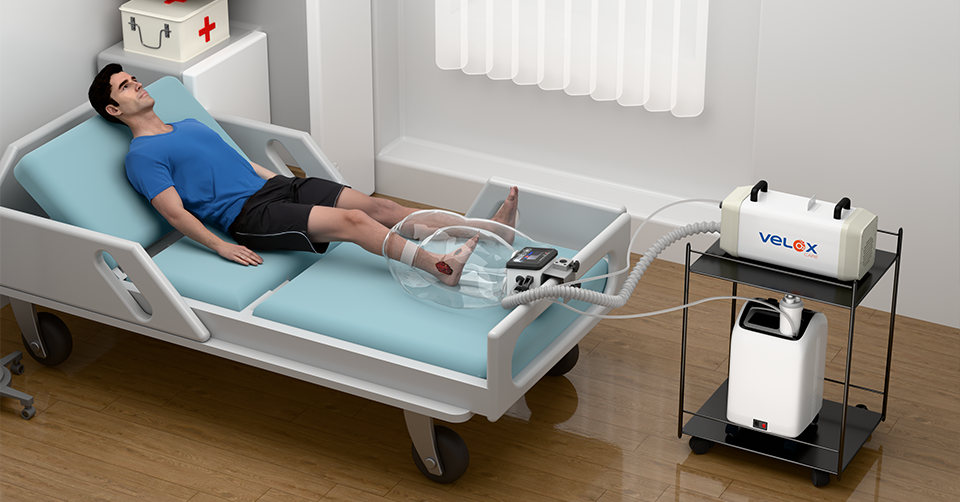
Topical Warm Oxygen Therapy combines oxygen delivery with controlled heat. The heat induces vasodilation, opening microcapillaries and improving oxygen transport to tissue.
| Mechanism | Result |
|---|---|
| Warmth increases blood flow | Enhanced local circulation |
| Oxygen delivered continuously | Boosts metabolic activity |
| Oxygen saturation at wound site | Accelerates granulation |
| Reduces anaerobic bacterial activity | Lowers infection risk |
📌 Studies show up to 52% faster healing in chronic DFU patients using Topical Warm Oxygen Therapy versus conventional wound management.
🧪 Clinical Evidence
STRIDE Trial (2023) – Topical Warm Oxygen Therapy demonstrated significantly improved granulation rates in diabetic foot ulcers compared to conventional treatment.
Systemic and Local Effects of Warm Oxygen Exposure Study (Volunteers) – Confirmed enhanced local tissue perfusion due to heat-induced vasodilation.
Experimental DFU Rat Model Findings – Faster epithelialization and angiogenesis reported with controlled oxygen and temperature exposure.
Internal VELOX Care Case Review (2022–2024) – Healing achieved within 12–18 therapy sessions in non-healing DFU cases; multiple grade 3–4 ulcer cases avoided amputation.
🌡️ Why Topical Warm Oxygen Therapy Works Better
✔ Wagner Grade 2–4 DFU
✔ Poor granulation despite standard dressings
✔ Post-debridement or failed skin graft
✔ Chronic wounds >90 days
✔ Neuro-ischemic ulcers with non-critical ischemia
✔ Amputation stump healing cases
✔ Patients unsuitable for Hyperbaric Oxygen Therapy
🔎 Clinical Insight
“Most patients who failed to respond to weeks of standard wound care began showing granulation within 10–15 VELOX sessions. The heat-modulated oxygen therapy reactivated stalled healing in complex DFU.”
— Consultant Diabetologist, South Zone
🧠 Summary – Why DFUs Stop Healing
| Root Cause | Why It Matters |
|---|---|
| Local hypoxia | Cells can’t regenerate |
| Microcirculatory blockade | Oxygen cannot reach damaged tissue |
| Chronic inflammation | Healing gets “stuck” |
| Infection | Increases oxygen demand |
📌 To restart healing, oxygen must be delivered locally and in active biochemical form—not passively.
🚀 The Way Forward
Topical Warm Oxygen Therapy directly addresses the two major barriers to DFU healing—oxygen deficiency and poor microcirculation.
It achieves this by:
✔ Delivering oxygen at wound level
✔ Enhancing capillary dilation via therapeutic heat
✔ Improving antibiotic access
✔ Accelerating tissue repair
→ Available via VELOX Care, a clinically validated, portable device suitable for hospitals, wound clinics, and home care services.